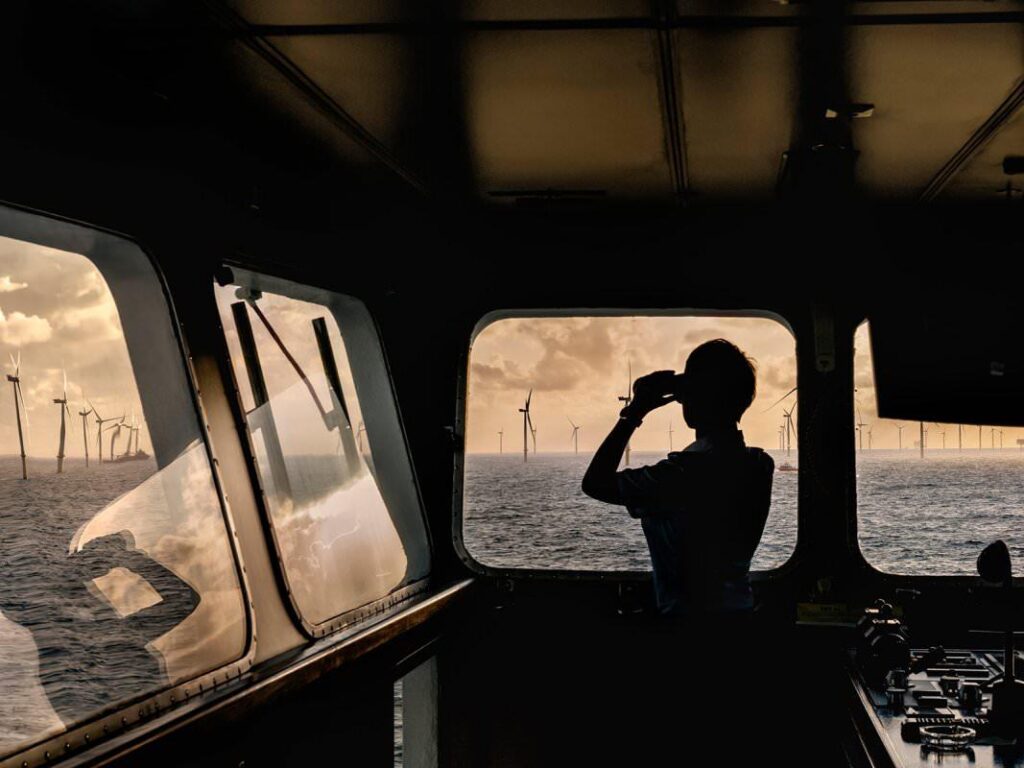
The bridge was unusually quiet.
Leadership under pressure rarely begins with a dramatic decision. More often, it begins with silence.
Outside, the South China Sea stretched endlessly toward the horizon. Dozens of offshore wind turbines stood against a pale morning sky while, far below the surface, hundreds of metres of high-voltage export cable waited to be laid across the seabed.
Everything was ready.
Months of engineering.
Countless calculations.
Weather routing.
Risk assessments.
Every detail had been discussed long before the vessel left port.
That was exactly how Hassan liked it.
He believed good preparation eliminated surprises.
Most of the time, it did.
“Bridge, weather update.”
The radio interrupted the silence.
The Chief Officer studied the latest forecast before looking out through the bridge windows.
“The low-pressure system is moving faster than expected.”
No one spoke.
Everyone on the bridge knew exactly what those words meant.
On deck, the cable continued its slow journey towards the seabed.
The tensioners moved with perfect precision.
The carousel rotated steadily beneath the crew’s feet.
Months of preparation had brought the project to this point.
Then the order came.
“Stop cable-lay operations.”
Within seconds, the atmosphere changed.
The deck crew secured equipment.
The ROV team paused their work.
Engineers gathered around computer screens.
Someone started calculating delay costs.
Someone else informed the client.
A project worth millions had suddenly become a waiting game.
Hassan hated waiting.
He opened another weather application.
Compared different forecasts.
Reviewed alternative work sequences.
Adjusted tomorrow’s planning.
There had to be another solution.
There always had been.
Across the mess room, Jeroen quietly poured himself a cup of coffee.
“You look surprisingly relaxed,” Hassan said as he walked in.
Jeroen smiled.
“I’ve been accused of worse.”
Hassan poured himself a coffee.
“I don’t understand it.”
“What?”
“We’re losing valuable time.”
“We are.”
“The client won’t like this.”
“Probably not.”
“This vessel costs a fortune every hour we’re standing still.”
“It does.”
Hassan looked at him.
“Then why are you standing here?”
Jeroen took another sip.
“Because standing somewhere else won’t change the weather.”
Hassan shook his head.
“I can’t just sit still.”
“I know.”
“I need to do something.”
“I know.”
Rain tapped softly against the windows.
Neither of them spoke.
Finally, Jeroen broke the silence.
“What makes you good at your job?”
Hassan answered without hesitation.
“I solve problems.”
Jeroen smiled.
“No.”
Hassan frowned.
“You solve the problems that can be solved.”
He paused.
“That’s a very important difference.”
Outside, the sea continued doing exactly what seas have always done.
The wind increased.
The waves grew.
Completely indifferent to budgets, deadlines and project plans.
“You know,” Jeroen said quietly, “I’ve worked offshore for almost thirty years.”
Hassan nodded.
“I’ve seen storms delay projects.”
“I’ve seen vessels wait for days.”
“I’ve seen perfect plans disappear before breakfast.”
He looked at Hassan.
“And I’ve never once seen the wind change direction because somebody refused to accept it.”
For the first time that morning, Hassan laughed.
Not because it was funny.
Because it was true.
He looked at his laptop once more.
The forecast hadn’t changed.
The sea hadn’t changed.
The decision hadn’t changed.
Only one thing still could.
His response.
Slowly, he closed the laptop.
The sound echoed through the quiet room.
Jeroen noticed.
He said nothing.
He didn’t need to.
Almost two hours later, the bridge received another weather update.
“The wind is easing.”
The whitecaps slowly disappeared.
The vessel prepared to resume operations.
The carousel began turning again.
The cable continued its silent journey towards the seabed.
As though nothing had happened.
Standing at the bridge door, Hassan adjusted his helmet.
“I’ve spent the last two hours trying to control something that never even knew I existed.”
Jeroen smiled.
“The sea has a way of reminding us of that.”
Hassan looked across the water.
The turbines turned steadily once more.
The wind had never been against him.
It had simply been the wind.
He stepped onto the deck.
This time, he wasn’t carrying the weather with him.
Only his helmet.
Control is a good servant.
But it makes a poor captain.